
Urine output is a core clinical sign of kidney function, and in the ICU it is expressed in mL/kg/h. The milliliters come from the collection bag, but the kilograms can come from more than one source. Actual body weight, ideal body weight and adjusted body weight can each be used in the calculation, and until recently, KDIGO guidelines did not specify which one is correct.
That choice changes the diagnosis. In patients with obesity, using actual body weight may overestimate acute kidney injury (AKI), and as actual body weight rises, more patients are classified as oliguric [1][2]. The public review draft of the KDIGO 2026 guideline on AKI now proposes an answer in its definition: urine output criteria are calculated on ideal body weight [3].
A normal urine output is approximately 0.5 to 1.0 mL/kg/h, so a healthy 70 kg man produces around 35 to 70 mL of urine per hour [4]. The KDIGO 2012 guideline defined AKI by urine output as a volume below 0.5 mL/kg/h for 6 hours, and staged it as follows [5]:
| KDIGO stage | Urine output criterion (KDIGO 2012) |
|---|---|
| Stage 1 | <0.5 mL/kg/h for 6 to 12 hours |
| Stage 2 | <0.5 mL/kg/h for ≥12 hours |
| Stage 3 | <0.3 mL/kg/h for ≥24 hours, or anuria for ≥12 hours |
The 2012 guideline did not specify which weight belongs in the denominator. Its own research recommendations listed “differing weights (actual, ideal body weight, lean body mass)” as an open question, along with whether the criteria describe an average or a persistent reduction over the period [5]. A 2020 KDIGO controversies conference came back to the same gap and asked future guidelines to address how body composition affects the interpretation of urine output [6]. Every stage of acute kidney injury defined by urine output depends on the answer.
Each weight in common ICU use comes from a different tradition:
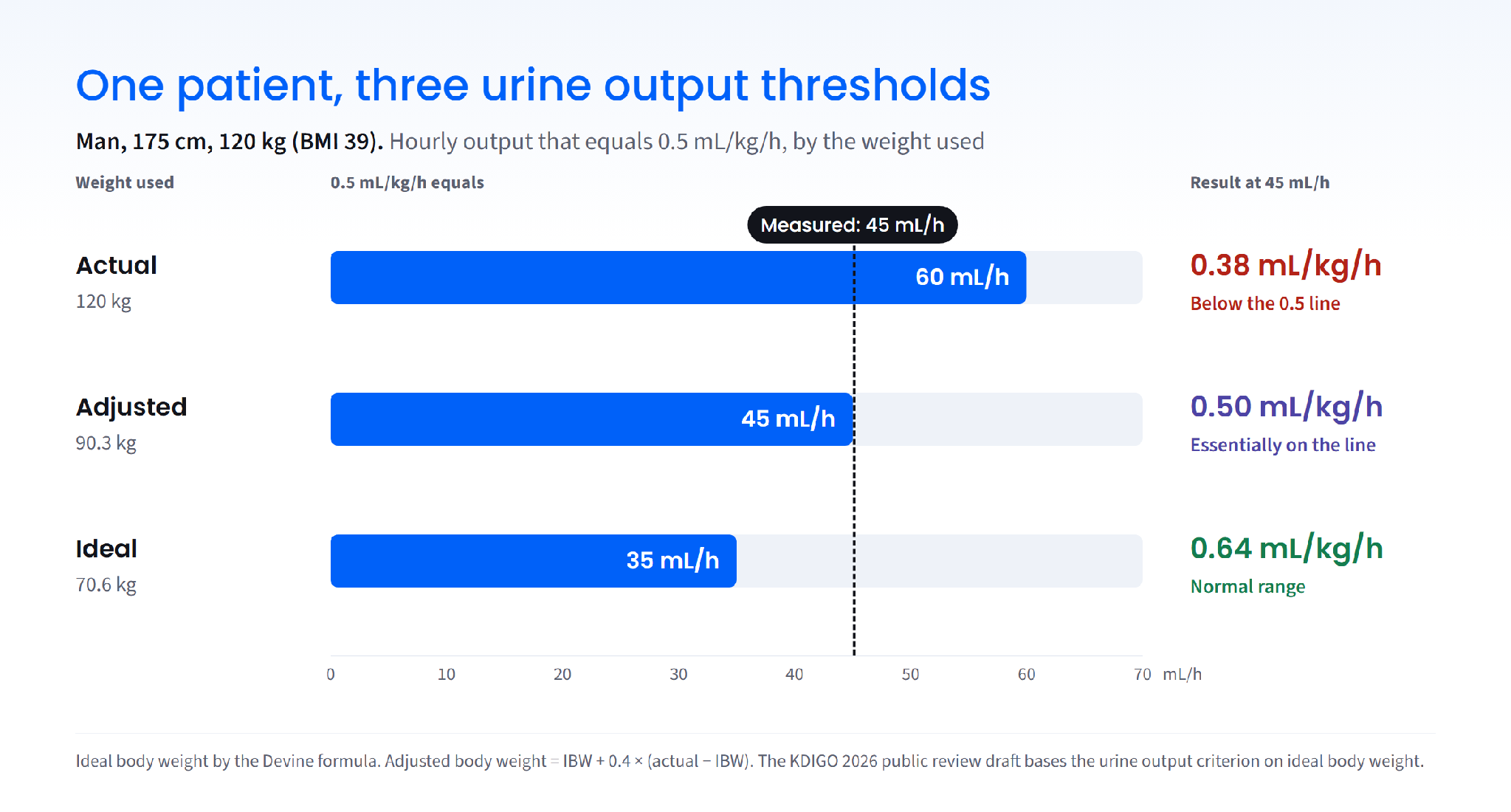
The difference is easy to underestimate until it is worked through for one patient. Take a man 175 cm tall weighing 120 kg (BMI 39). His IBW is 70.6 kg and his AdjBW is 90.3 kg. The hourly urine output that marks the 0.5 mL/kg/h line is:
| Weight used | Weight | 0.5 mL/kg/h equals | 6-hour volume at threshold |
|---|---|---|---|
| Actual | 120 kg | 60 mL/h | 360 mL |
| Adjusted | 90.3 kg | 45 mL/h | 271 mL |
| Ideal | 70.6 kg | 35 mL/h | 212 mL |
If this patient produces 45 mL every hour for 6 hours, his output is 0.38 mL/kg/h by actual body weight, which is below the 0.5 mL/kg/h line. By ideal body weight it is 0.64 mL/kg/h, inside the normal range. By adjusted body weight it is 0.50 mL/kg/h, essentially on the line. One patient and one collection bag produce three different answers.
Four ICU cohorts have compared actual body weight with a height-based weight [1][2][10][12].
Actual body weight finds more AKI in patients with obesity. The gap matters most in obesity, which affects around 20% of ICU patients [11]. AKI by urine output was diagnosed in 41.4% of 493 patients by actual body weight and 31.2% by ideal body weight in one study [10], and in 29.2% versus 20.8% of 14,725 patients in another [1]. In the largest study, with 15,322 patients, oliguria by actual body weight rose almost linearly with body weight until “virtually all patients > 120 kg” met the criteria. By ideal body weight, it stayed stable across weight categories [2].
The extra cases identified by actual body weight show no significant excess mortality. In two of the studies, patients who met the AKI criterion by actual body weight alone showed no significant increase in mortality [1][10]. The largest study found that ideal body weight predicted urine output best and classified 90-day mortality and acute kidney disease more accurately, and concluded that “IBW should be preferred to normalize UO in critically ill patients” [2].
The size of the gap depends on the population. A study of 569 patients with sepsis identified only a small difference: 26.9% by actual body weight and 24.6% by ideal body weight, with no significant difference in 90-day mortality [12]. However, at the low end of the weight range, the effect of ABW vs. IBW resulted in delayed diagnosis. In an underweight patient, actual body weight sits below ideal body weight, so oliguria may be recognized later, leading the study’s authors to conclude “clinicians should be cautious when diagnosing urinary AKI using actual body weight” [12]. Similarly, the European Renal Best Practice position statement suggested ideal body weight is most accurate for both obese and cachectic patients in 2012 [13].
The KDIGO 2026 AKI and acute kidney disease (AKD) guideline was released as a public review draft in March 2026, and the final version is still in preparation [3][14]. Practice Point 1.1.1 lists the functional and structural criteria for AKI in Table 1, and the urine output criterion now reads: “Mean urine volume of less than 0.5 ml/kg/h (based on ideal body weight) for ≥6 hours” [3]. The wording may change in the final guideline.
Two words in that line address the open questions from 2012. “Ideal body weight” fixes the denominator. “Mean” points to an average over the 6-hour window. The draft’s staging table keeps the 0.5 and 0.3 mL/kg/h thresholds by stage, with the durations written as more than 12 and more than 24 hours [3]. The urine output criterion does not name a formula for ideal body weight. Devine is the formula the comparison studies used [1][2]. A practical step, not stated in the draft, is for each ICU to agree on one formula and to record a measured height, because every height-based weight depends on it.
The draft also brings urine output into drug dosing. Practice Point 4.5.2 states that “trends in SCr and urine output should be used to guide dosing of drugs excreted by the kidney,” and Practice Point 4.5.1 advises against basing doses on GFR equations that assume a steady state during AKI [3]. In the draft, urine output informs prescribing as well as diagnosis, which widens the role it plays in KDIGO-based kidney disease management.
In our example, the threshold for hourly urine output based on ideal body weight is 35 mL/h. That makes the margin for error on hourly urine output measurements relatively small, meaning the accuracy of the hourly milliliters decides the diagnosis just as much as the choice of kilogram.
Manual hourly measurement has documented gaps. In a prospective study of 44 cardiac surgery patients in one ICU (187 patient-hours), 39% of hourly values had no bedside nurse recording, values were entered 47 minutes late on average, and nurses overestimated hourly output by 19.9 mL on average against a scale. In the same study, a different electronic sensor had a mean bias of 2.29 mL per hour against the scale (SD 34.0 mL), and its data were missing for only 8.6% of hours [15]. The nurses’ average error is larger than the 10 mL/h that separates the adjusted and ideal body weight thresholds in the worked example.
In a retrospective study of 15,724 ICU patients, only 26% received intensive urine output monitoring, defined as hourly recordings with no gaps longer than 3 hours over the first 48 hours. Those patients had higher rates of AKI detection (OR 1.22). Intensive monitoring was associated with improved survival among patients with AKI, and with less fluid overload in all patients [16]. Each missed or estimated hour adds to the hidden cost of manual urine measurement.
Automated continuous urine output monitoring removes the manual hourly reading. It measures urine output continuously and in real time, sends the data to the EMR and alerts the care team, so the hourly record no longer depends on a nurse reading the collection bag. With that record, the 6-hour mean in the KDIGO 2026 definition can be calculated for any window against the ideal body weight the unit has standardized on. Accurate urine output measurement also supports fluid management in critically ill patients.
For a patient close to ideal body weight, the choice of kilogram changes little. For the roughly one in five ICU patients with obesity [11], and those who are underweight, it can decide when and/or whether AKI is flagged at all. The evidence and the KDIGO 2026 draft point in the same direction: urine output criteria should be calculated using ideal body weight and applied the same way on every shift.
The milliliters need the same consistency. Automated continuous monitoring sends hourly urine output to the EMR on every shift. As studies demonstrate, gaps in hourly recording reduce AKI detection and ultimately impact patient outcomes [16].
What is normal urine output per hour?
In adults, normal urine output is approximately 0.5 to 1.0 mL/kg/h, about 35 to 70 mL per hour for a 70 kg man [4]. A mean output below 0.5 mL/kg/h for at least 6 hours meets the KDIGO urine output criterion for AKI [3][5].
How do you calculate urine output in mL/kg/h?
Divide the urine volume collected over a period by the number of hours, then divide by body weight in kilograms. For example, 270 mL over 6 hours is 45 mL/h, and in a patient with an ideal body weight of 70 kg that is 0.64 mL/kg/h. The KDIGO 2026 public review draft uses the mean over at least 6 hours, based on ideal body weight [3].
Should urine output be calculated with actual or ideal body weight?
Ideal body weight. In patients with obesity, actual body weight classifies more patients as oliguric, but the extra AKI cases it identifies do not carry the excess mortality seen in AKI [1][10]. In a cohort of more than 15,000 ICU patients, ideal body weight predicted urine output better than actual body weight [2], and the KDIGO 2026 public review draft bases the urine output criterion on ideal body weight [3].
What does the KDIGO 2026 draft change in the AKI definition?
The public review draft defines the urine output criterion as a mean urine volume below 0.5 mL/kg/h, based on ideal body weight, for at least 6 hours. It adds serum cystatin C and biomarkers of kidney damage to the AKI criteria, and it uses trends in serum creatinine and urine output to guide dosing of drugs excreted by the kidney [3]. The final guideline is still in preparation [14].
How do you calculate ideal body weight?
The Devine formula is 50 kg + 2.3 kg per inch above 5 feet for men, and 45.5 kg + 2.3 kg per inch above 5 feet for women [7]. In metric form, that is 50 + 0.91 × (height in cm − 152.4) for men and 45.5 + 0.91 × (height in cm − 152.4) for women [8]. A man 175 cm tall has an ideal body weight of 70.6 kg.
